A custom pantry cabinet is built to your wall and to the food you actually store, not picked from a catalog of set sizes. Before you buy one, settle three things: which build type fits (stock, semi-custom or custom), where the cabinet sits in the kitchen, and what the quote spells out.
Alpha Closets & Murphy Beds Inc builds custom cabinetry in its own cabinet shop in Gulf Breeze, so this guide is written from the buyer’s side of that counter. It covers the choices that matter for a pantry. For price figures, see how much custom cabinets cost. For what goes on the shelves, see organizing with custom pantry storage.
What is a custom pantry cabinet?
A custom pantry cabinet is storage for dry and canned food that a shop designs around your space, then builds and installs. It usually takes one of four shapes:
- A tall cabinet wall: floor-to-ceiling doors beside or between other cabinets.
- A pull-out unit: a narrow cabinet whose shelves slide out as one piece, useful in a gap too small for a door.
- A walk-in pantry with built-ins: a small room with cabinets and shelves on two or more walls.
- A butler’s pantry: a pass-through or side space between kitchen and dining room, often with counter and cabinets.
Which one fits depends on the wall you have. A tall cabinet wall suits a plain kitchen. A pull-out suits a narrow gap. Walk-ins and butler’s pantries need floor area first, so measure what you can spare before you fall for a photo.
Stock, semi-custom or custom for a pantry
Stock cabinets come in fixed sizes. Custom cabinets are cut and built to the actual wall. Semi-custom sits between them: usually set box sizes with a wider choice of options. There’s no single rulebook, so ask any seller what they mean by the term and which sizes and changes it covers.
A pantry shows the difference fast. A stock tall cabinet leaves filler gaps when your wall isn’t a standard width, and its shelves are set where the factory put them. A custom one runs wall to wall and is divided around your cereal boxes, tall oil bottles and small-appliance storage.
Can you customize stock cabinets? Yes, to a point. People add pull-outs, change doors and paint them, and that works when the room already suits standard sizes.
It stops working when the wall, a window or a soffit forces odd dimensions. Then you pay for filler pieces, or you pay for a build that fits.
Where a pantry cabinet should go in a Gulf Coast kitchen
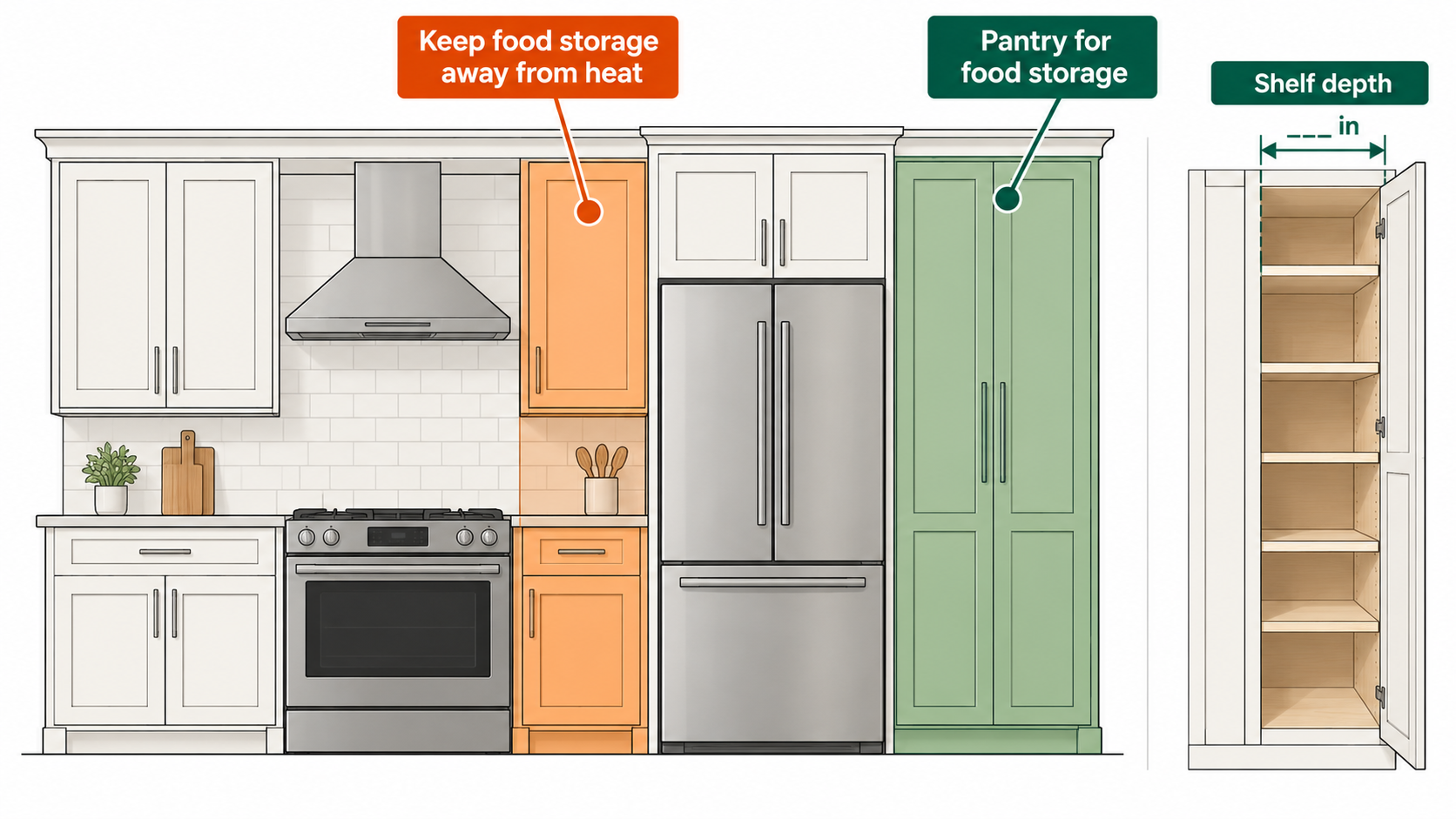
Put it in the coolest part of the kitchen. NMSU Cooperative Extension’s guide to storing food says: “Keep foods in the coolest cabinets in the kitchen, not near the oven, stove, or refrigerator exhaust.” The same publication (revised April 2025) says “The storage temperature should be kept at about 50°F to maintain food quality, although 60 to 70°F is acceptable,” and to “select dry areas with little or no humidity, if possible.”
That matters on the Gulf Coast. A kitchen here runs warm and damp for much of the year, and the wall beside a range is the worst spot for dry food. So when the kitchen layout gives you a choice, put the pantry cabinet away from the oven and refrigerator vents, and on an interior wall rather than a poorly ventilated exterior one.
Treat that as a planning rule, not a promise about any cabinet’s performance. Ask the shop how it handles moisture at raw edges and finish, which the materials section below covers.
Framed, frameless or inset doors
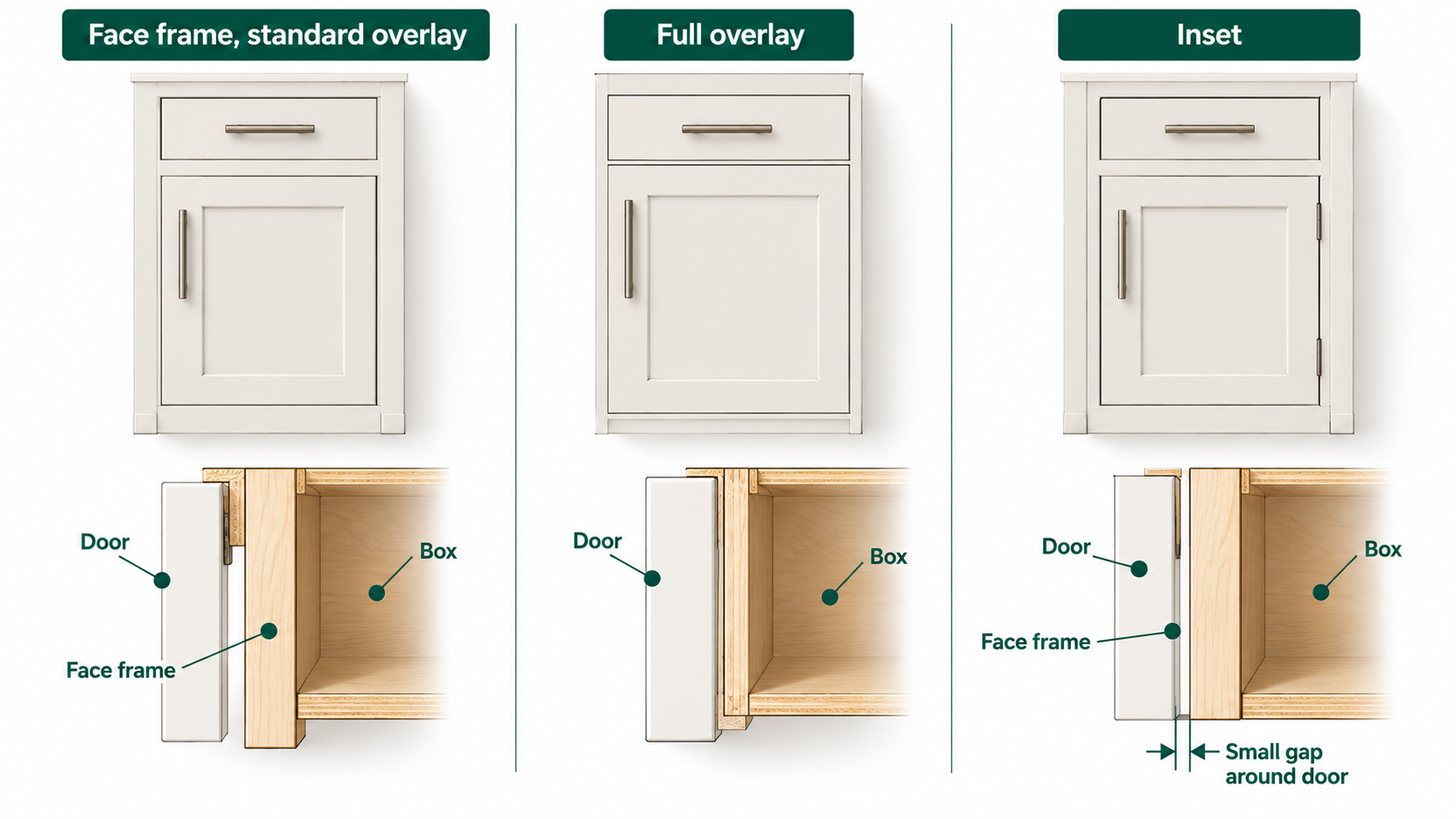
Three terms come up in every showroom. The Kitchen Cabinet Manufacturers Association (KCMA) defines them in its glossary.
| Term | KCMA’s wording | What it means for a pantry |
|---|---|---|
| Face frame | “The traditional cabinet face is constructed of vertical “stiles” and horizontal “rails”” | The frame narrows the door opening a little |
| Frameless | “The frameless cabinet is constructed without any face framing. Doors and drawers are mounted to the sides of the cabinet.” | Full-width access to shelves |
| Full overlay | “Cabinet doors and drawers are sized large enough to cover the cabinet face with only minimal clearances between them.” | Doors cover the frame with small gaps |
| Full inset | “Cabinet doors are fitted into the face frame and are flush with the frame.” | Doors sit flush, which is a tighter fit to build |
KCMA adds that “inset cabinetry, which is a specialized type of framed cabinetry, remains the most premium option.” If you’re searching for inset custom cabinets, that’s the style: flush doors in a face frame. The look is crisp. The trade-off is that flush doors have to be fitted closely, so the shop’s build and finish quality show more.
For a pantry, frameless gives the widest opening. Face frame and inset give a classic look. Neither is wrong, so decide by how you reach the shelves.
Melamine, plywood or hardwood for a pantry
Alpha builds in furniture-grade melamine in multiple colors, stained or painted hardwood, and hardwood plywood.
- Melamine is a colored laminate fused to a particleboard or fiberboard core. It wipes clean and costs less. Its weak points are chipped corners, poor edge banding (the thin strip that covers a raw panel edge) and a core that can swell if soaked.
- Hardwood plywood is layered veneer. It holds screws well and resists sagging across a span. It costs more than melamine.
- Solid or hardwood faces look and age well and can be refinished. They expand and contract with humidity, so wide doors need good construction. They cost the most.
- Painted or stained finishes depend on the finishing process: sanding, sealing and coating. A shop with its own finishing area controls dust and drying. Alpha has an on-site finishing shop.
Pantry shelves carry jars, cans and flour bags, so span and thickness decide sag. Long unsupported shelves bow. Ask how thick the shelf is, whether it has edge reinforcement or a center support, and what the drawer slides and pull-out hardware are.
Soft-close, full-extension slides are what you’ll feel every day. Alpha is a TAG Hardware partner.
Plan the pantry around what you store
Start with an inventory, not a catalog. Group what you keep: tall bottles, cans, boxes, bulk bags, small appliances, paper goods. Measure the tallest item in each group. Then ask the designer to divide the cabinet around those heights.
More shelves isn’t more storage. Wasted vertical gaps and shelves too deep to see the back are the usual losses. Adjustable shelves, a few drawers for heavy items and a pull-out for the narrow gap each cost design time, which is worth paying for.
The same planning applies to a mudroom wall: list what lands there (shoes, bags, coats, pet gear) and build around it. If you want custom mudroom cabinets, ask the shop whether it builds them.
What a custom pantry cabinet quote should say
Two quotes for the same pantry can cover different things. Ask for these, in writing:
- Dimensions and layout: a drawing with wall length, height and the shelf and drawer layout.
- Box material and thickness: melamine, plywood or hardwood, and shelf thickness.
- Edge banding and back panel: what covers raw edges, and whether the back is a thin skin or a full panel.
- Door style and finish: framed, frameless or inset, and the finish process (painted, stained or laminate).
- Hardware: drawer slides, hinges and pull-outs, named.
- Installation: who installs, what the price includes, and whether old cabinets are removed.
- Timeline: when the build starts and when it’s installed.
Compare quotes line by line. A lower number often leaves out items on this list. Our custom cabinet cost guide shows why published prices disagree.
How buying from a local shop works
Alpha designs, builds and installs in one place. The cabinets are made in the company’s own Gulf Breeze cabinet shop and finished in its on-site finishing shop. Installers are company employees, so the people who set the cabinet work for the company that built it. Alpha is licensed and insured.
The typical timeline is 4 to 8 weeks from deposit to installation, and some projects take longer. The showroom is at 6084 Gulf Breeze Pkwy, Gulf Breeze, FL 32563.
Custom pantry cabinet questions
What are semi-custom cabinets?
Semi-custom cabinets sit between stock and custom. They usually come in set box sizes with more options than stock. There is no single rulebook, so ask the seller what sizes and changes its semi-custom line allows.
Can I customize stock cabinets for a pantry?
Yes, to a point. You can add pull-outs, change doors and repaint. It works when your wall fits standard sizes. If the space is odd, a custom build avoids filler gaps.
How deep should a pantry cabinet be?
Set it from what you store, not from a number. Measure your deepest regular item and ask the designer whether shelves that deep will leave the back visible. Deeper isn’t better if you can’t see the rear.
How long does a custom pantry cabinet take?
Alpha’s typical lead time is 4 to 8 weeks from deposit to installation. Some projects take longer.
Plan your pantry with Alpha
A good pantry cabinet starts with your wall and your food, then a quote that names every part. Alpha Closets & Murphy Beds Inc designs, builds and installs custom cabinetry in Gulf Breeze. Call (850) 934-9130 or use the button below.