How much does a custom closet cost? Anywhere from about $1K to $80K, and the gap is mostly size and materials. Alpha Closets & Murphy Beds Inc says a custom reach-in typically runs $1K to $10K and a custom walk-in $3K to $80K, as of October 2026. Hardware, layout and design time move the number after that.
Those ranges are wide on purpose. This guide explains why every cost guide you’ll find gives a different figure, how to turn a per-foot price into a number for your closet, and what a written quote should spell out.
Typical prices by closet type
A reach-in closet is one you stand in front of, usually a shallow recess behind doors. A walk-in closet is large enough to step inside, with storage on two or more walls.
Alpha’s typical ranges, from the company, as of October 2026:
- Reach-in: $1K to $10K
- Walk-in: $3K to $80K
These are typical ranges, not quotes. Your closet lands where its wall length, materials and hardware put it, and the sections below show how much each one moves the price.
Why the cost guides disagree
Search for the answer and you’ll get three different ones. The numbers aren’t wrong so much as they’re measuring different things.
| Guide | What it says | Unit |
|---|---|---|
| HomeAdvisor (2026) | Average $2,136, most spend $1,080 to $3,229 | Whole closet |
| HomeAdvisor (2026) | “Plan for $28 to $40 per square foot” | Square foot |
| Fixr (2025) | $2,500 to $5,000, national average $3,500 | Whole closet |
| Fixr (2025) | $150 to $450 per linear foot | Linear foot |
| Thumbtack (2026) | $3,000 to $5,000 average for a custom organization system | Whole closet |
A linear foot is one foot of wall length that gets storage. A square foot is floor area. A closet with 12 feet of wall to fit out has 12 linear feet, whatever the floor area is.
Look at the spread between the two per-foot figures. Fixr’s $150 to $450 per linear foot and HomeAdvisor’s $28 to $40 per square foot can’t be compared until you pick a closet and convert one into the other. The guides also differ on scope, so check whether each price includes installation and what material it assumes. These are national figures from third-party sites, not Alpha’s pricing.
Turn per-foot prices into your closet’s number
Thumbtack gives one worked case: “To customize a larger walk-in closet with 33 linear feet would cost $4,000-$8,000.” Divide to see the rate that implies:
- $4,000 ÷ 33 ft is about $121 per linear foot.
- $8,000 ÷ 33 ft is about $242 per linear foot.
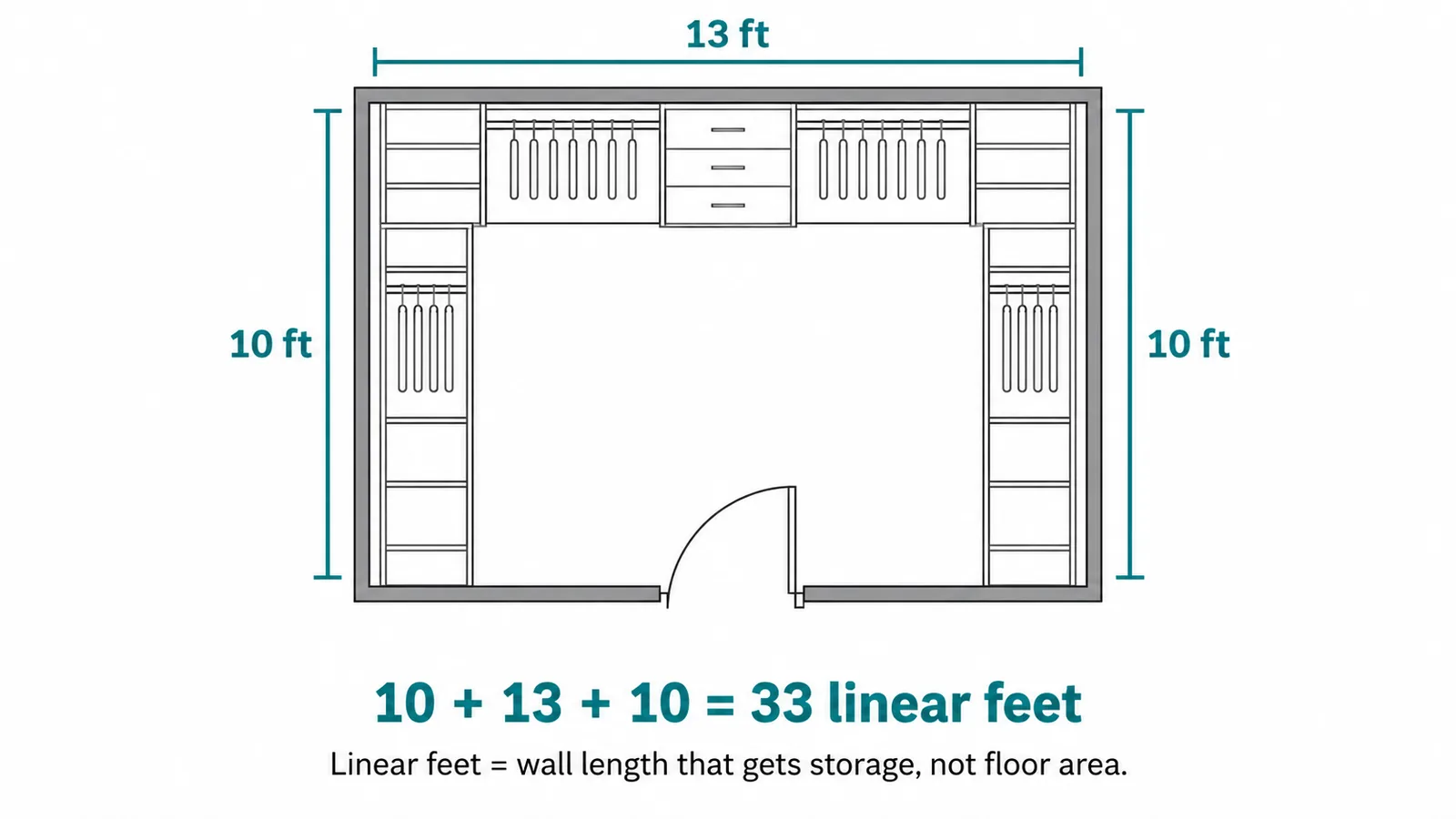
Now run the same 33 feet through the other guides:
- Fixr’s $150 to $450 per linear foot gives $4,950 to $14,850.
- Thumbtack’s own “basic white or oatmeal laminate” figure of $125 per linear foot gives $4,125.
Same closet, and the answers run from $4,125 to $14,850. That’s not a contradiction. Basic laminate and a finished hardwood design are different closets, and they price differently.
For square feet, take a hypothetical 6 by 8 ft closet, which is 48 sq ft of floor. At HomeAdvisor’s $28 to $40, that’s $1,344 to $1,920. The guide doesn’t say whether it counts floor area or something else, so treat that as a low-end marker for a simple build, not a budget.
Measure your wall length, pick a per-foot rate that matches the material you want, and you have a range to take into a quote. Then check the quote against the list below.
What moves the price most, in order
Most closets cost what they cost because of these, roughly in this order.
- Size and how many walls get storage. More wall means more panels, rods and shelves. This usually matters most, and it is why a reach-in and a walk-in sit so far apart.
- Materials. Melamine costs least, hardwood plywood costs more, and solid wood or a painted or stained finish costs the most. The next section covers each.
- Hardware. Drawer slides, hinges, rods and pull-outs are what you touch every day, and they’re where price differences hide. A soft-close, full-extension drawer slide costs more than a basic one, and you’ll feel it every morning.
- Complexity. Sloped ceilings, corners, a window in the wall and crown or trim details all add design and cutting time.
- Design time. A layout built from what you own takes longer than one picked from a catalog. Ask whether it’s included in the price or billed on its own.
- Install conditions. Access, removing the old closet system and repairing the wall behind it all take labor.
A lot of this is invisible in a per-foot rate, which is why two quotes for the same closet can differ by thousands.
Melamine, plywood or solid wood: what you pay for
Melamine is a colored, durable laminate fused to a particleboard or fiberboard core. It wipes clean, resists scuffs and costs the least. Its weak spots are raw cut edges and chipped corners if the edge banding is poor, and a core that swells if it gets soaked.
Hardwood plywood is layered veneer with a hardwood face. It holds screws well, resists sagging across a span and can be painted, stained or finished with veneer. It costs more than melamine.
Solid wood looks the best and can be refinished. It also expands and contracts with humidity, which matters on wide panels and doors, and it costs the most. Shops often use solid wood on face frames, doors and trim, with stable panels behind.
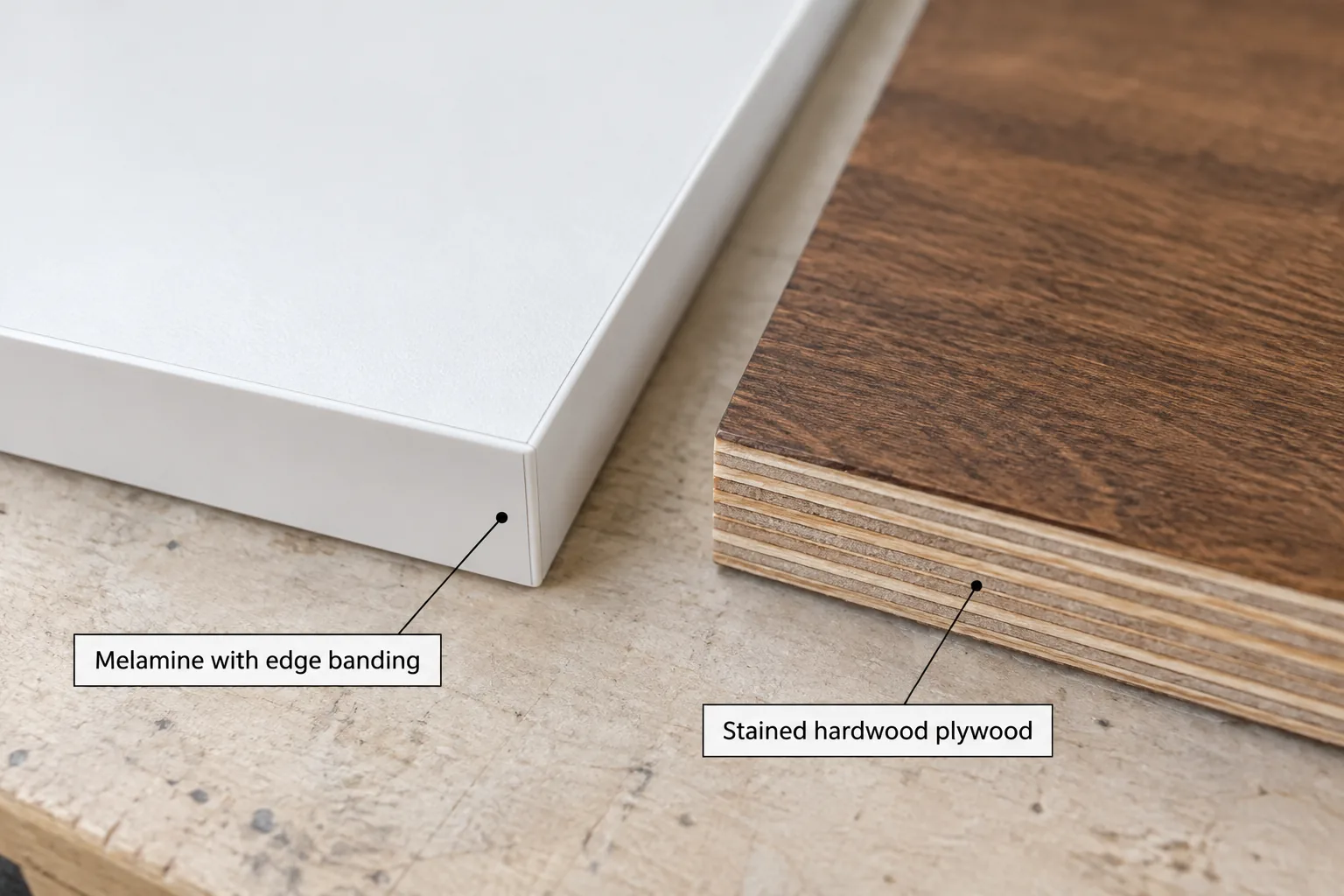
Those panel products fall under a federal rule. The EPA lists “hardwood plywood, medium-density fiberboard, and particleboard” among the composite wood products covered by its formaldehyde emission standards. Melamine sits on a particleboard or fiberboard core, so it is fair to ask a shop what core your panels use.
Alpha builds in furniture-grade melamine in multiple colors, and also in stained or painted hardwood and hardwood plywood, in its own Gulf Breeze cabinet shop. Painted and stained finishes need sanding, sealing and coating, and a shop with its own finishing department controls dust and drying.
What a quote should include
Two quotes are only comparable if they list the same things. Ask each shop to put these in writing:
- Panel material and thickness. Thin shelves sag across a long span. Ask what the shelves are made of, how thick they are and how far they run unsupported.
- Edge banding. The thin strip that covers the raw edge of a panel so the core doesn’t show or chip. Ask what covers the edges, including the shelf fronts.
- Drawer slides and hinges. Soft-close or not, full-extension or not, and the brand if the shop will name it.
- Trim. Whether crown, baseboard and filler pieces are in the price, or you’ll see them later.
- Installation. Who installs, and whether they’re employees or subcontractors. Alpha’s installers are company employees.
- Removal. Taking out the old shelves and rods, and patching the wall behind them.
- Design time. Whether it’s included and how many revisions you get.
- Warranty scope. What it covers and for how long. Alpha’s closet warranty is 10 years on workmanship.
- Tax and deposit. How sales tax is handled and what the deposit is.
For hardware and add-ons, see Alpha’s closet accessories page.
Custom closet or a kit
A kit prices parts. A custom closet prices design, build and installation.
A closet kit is standard components that you fit to your room. That works for a straight wall with no obstacles, and it’s a reasonable place to start if the budget is tight. The trade-off is filler gaps, standard sizes that don’t land on your wall and a layout built around the product, not around what you own.
Custom is cut to the room. It plans around a window, an attic hatch, a sloped ceiling or a bulkhead, matches the trim and starts from your clothes and shoes. You pay more because someone designs it, builds it and installs it.
Neither is wrong. If your wall is plain and your needs are simple, a kit may be enough. If your closet has an odd shape, or you’re frustrated that nothing fits, that’s where custom earns its price.
Timeline and what happens next
Alpha’s lead time is typically 4 to 8 weeks from deposit to installation, as of October 2026. Some projects take longer. The clock starts at the deposit.
That’s worth knowing before you compare quotes. A lower price with a longer wait isn’t a better price if you need the closet before a move or a guest visit.
For a custom closet from Alpha, start on the custom closets page.
Custom closet cost questions
What is the average cost of a custom closet?
It depends which guide you read. HomeAdvisor says a custom closet averages $2,136, with most homeowners spending $1,080 to $3,229. Fixr gives a $3,500 national average, and Thumbtack gives $3,000 to $5,000. Alpha’s own typical ranges are $1K to $10K for a reach-in and $3K to $80K for a walk-in.
What is the cost per square foot for a custom closet?
HomeAdvisor says to plan for $28 to $40 per square foot. Fixr prices by linear foot instead, at $150 to $450. The two can’t be compared until you pick a closet size, so convert both to a total before you compare.
Is a custom closet worth it over a kit?
It depends on your wall. A kit suits a plain, straight space, and a custom closet suits one with an odd shape, an obstacle or a layout you can’t get from standard parts. Custom costs more because it includes design, building in a cabinet shop and installation.
How long does a custom closet take?
Alpha’s typical lead time is 4 to 8 weeks from deposit to installation. Some projects take longer.
Want a number for your closet?
Prices from guides are national figures, and Alpha’s ranges are wide because closets are. The fastest way to a real figure is a design for your actual wall. Alpha Closets & Murphy Beds Inc designs and builds custom closets in its own cabinet shop in Gulf Breeze. Call (850) 934-9130 or use the button below.