To organize a walk-in closet, empty one section at a time, sort what you own, then choose your walk in closet racks (the hanging rods, shelves and drawers) from that list. Plan the walls before the middle, and keep the air dry. This guide walks through the order, and what to hand to a professional.
Most advice starts with products. That puts the purchase before the plan, and you end up fitting your clothes to the bins instead of the other way around.
How do you organize a walk-in closet?
Sort first, then build storage around what’s left. Take everything out of one section, split it into keep, donate, sell and toss, count what stays by type, and pick racks and shelves to match that count. Then lay out the walls, and add lighting and seating last.
- Empty and sort one section.
- Count what you own by type.
- Choose walk in closet racks to match.
- Plan the walls, then the middle.
- Protect it from humidity and moths.
Sort one section at a time
A walk-in closet is easy to over-empty. If you pull out every garment at once, the bedroom floor becomes the closet for a week.
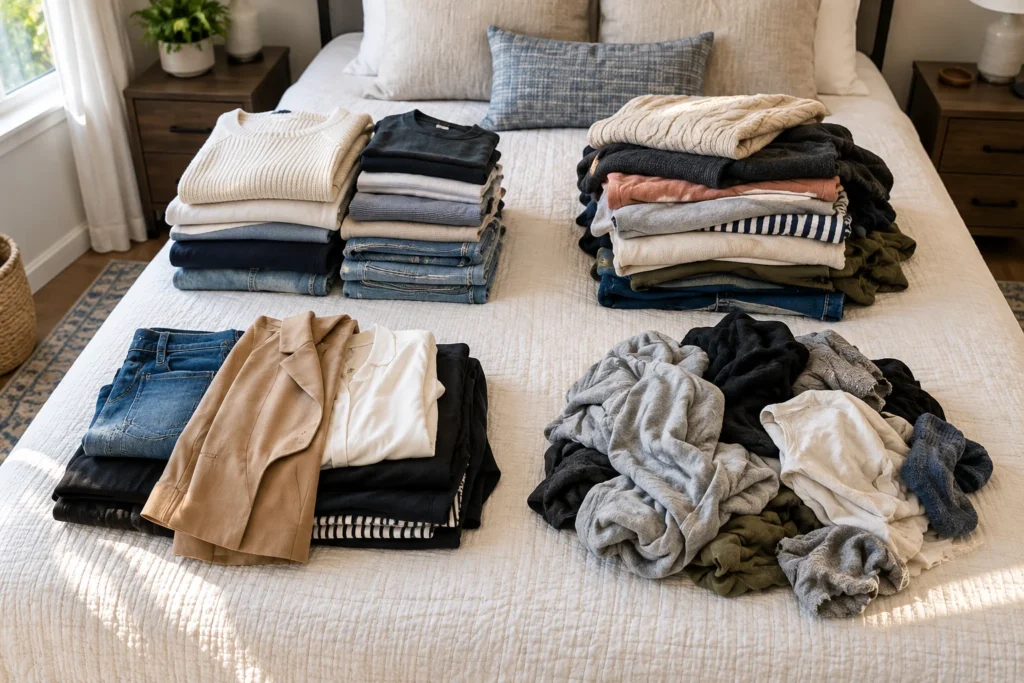
Penn State Extension’s decluttering guide says to “plan to do one small area at a time” and to “pick one closet, one drawer – only one.” It also suggests a box for each outcome: donate, sell, recycle, trash, keep and give. In a walk-in, treat each wall as one area.
Anything you haven’t worn in a long time goes in a box, not back on the rod. That’s a rule of thumb, not a standard, so set your own cutoff.
Count what you own before you choose walk in closet racks
Walk in closet racks are the parts that hold things: hanging rods, shelves, drawers and pull-outs. Choosing them first is how closets end up with the wrong mix.
Count what survived the sort, by type:
- Long hang: dresses, coats and robes that need a full drop.
- Short hang: shirts, folded-over pants and skirts. Two short-hang rods stacked one above the other are called a double hang.
- Folded: sweaters, jeans and T-shirts, which want shelves or drawers.
- Shoes and bags: these need their own shelves, cubbies or pull-outs.
Divide the closet by that count. If half your clothes are short hang, a long-hang wall wastes floor-to-ceiling space. If you own few dresses, one short run of full-length hanging is enough.
We aren’t giving rod heights or shelf depths here, because we found no published standard we could quote. Your designer sets them from the tallest garment you own.
Hang, fold or put it in a drawer
Match each item to the storage that suits its fabric and weight. This is general practice, not a rule from a source.
Heavy knit sweaters tend to stretch on hangers, so fold them on a shelf or in a drawer. Suits, dress shirts and anything that wrinkles easily belong on a rod. T-shirts and jeans can go either way, so pick whichever makes them easiest to see.
Visibility beats volume. A stack you have to dig through gets ignored, and what you can’t see you stop wearing.
Plan the walls first, then the middle
A walk-in has two or more walls of storage with an aisle between them. Put the hanging on the longest unbroken wall, drawers and shelves on the shorter ones, and leave the aisle clear.
Corners are the hardest spots. They’re deep and awkward to reach, so many designs use them for shelves rather than hanging. If you want an island or a bench in the middle, the aisle has to stay wide enough to pass on every side. Our walk-in closet dimensions guide shows the arithmetic.
Before you commit, measure each wall at the top and the bottom, and mark every vent, switch and door swing. Walls are rarely straight, and trim takes inches.
Keep humidity and moths out
On the Gulf Coast, damp air is a closet problem. The US EPA’s guide to mold and moisture says to keep indoor humidity below 60 percent, “ideally between 30 and 50 percent” relative humidity. A closet on an exterior wall or in a poorly vented room is the first place that goes wrong.
Moths add a second reason to keep things clean. The University of Maryland Extension’s clothes moth page says “soiled woolens are the primary food of clothes moth larvae” and that woolen articles “should be cleaned and stored in sealed boxes.” So wash or dry-clean wool before it goes on a high shelf, and leave a little space around stored items so air can move.
Lighting, benches and heavy shelving: ask a professional
Three parts of a walk-in are not DIY decisions.
- Lighting. How close a fixture can sit to stored clothing depends on the fixture type and the electrical code in your area. Ask an electrician or your building department, and don’t wire it yourself.
- Heavy shelving and long rods. Anything loaded with heavy items has to be fastened to the wall structure correctly. Ask the installer what holds it and how it was fastened.
- Benches and islands. A bench takes aisle space. Ask your designer to draw it on the plan with the clear walkway labeled.
When walk in closet racks should be custom
A closet system is made of standard parts fitted to the room. A custom closet is cut and built to the wall, so there are no filler gaps, and the layout starts from what you own.
Alpha Closets & Murphy Beds Inc builds custom closets in its own Gulf Breeze cabinet shop, and its installers are company employees. Alpha says a custom walk-in typically costs $3K to $80K, as of October 2026, and lead time is typically 4 to 8 weeks from deposit to installation. Closets carry a 10-year workmanship warranty.
For what moves the price, see how much a custom closet costs.
Materials are a trade-off. Melamine, a durable colored laminate, costs less.
Stained or painted hardwood and hardwood plywood cost more. Browse finishes and colors, and see the closet accessories page for rods, drawers and pull-outs. The features list is a good checklist before you plan.
Walk-in closet organization questions
How do I organize a small walk-in closet?
Sort one wall at a time, count what you own by type, and give the longest wall to the hanging you use most. Skip a center island and keep the aisle clear. A small walk-in works better with fewer, better-placed racks than with every shelf filled.
How many rods does a walk-in closet need?
It depends on your clothes, not on the room. Count long-hang and short-hang items. A double hang suits shirts and pants, but a closet full of dresses needs full-length runs. Ask your designer to base the number on your count.
How do I keep a walk-in closet from smelling musty?
Control moisture first. The EPA’s target is indoor humidity below 60 percent, ideally 30 to 50 percent. Air out damp items, wash before storing, and leave space between stored items so air can move.
Planning a walk-in closet?
Sort first, pick racks from the count, and plan the walls before the middle. If you’d like a designer to check your plan against your actual room, Alpha builds custom closets in Gulf Breeze. Call (850) 934-9130 or see custom closets.